
A guide to California premises liability law, who is responsible for your injury, and what it takes to build a strong claim.

Erick is extremely passionate about issues involving injustices where there is an apparent imbalance of power. Whether the imbalance involves a large corporation or a government entity that denies responsibility and minimizes the harm they have inflicted on his clients, Erick prides himself in helping victims obtain full and complete compensation.
A broken stair at an apartment complex. A spilled drink nobody cleaned up in a grocery aisle. A dark parking garage where you were attacked. Injuries like these happen on property someone else is responsible for. California law gives you a way to hold that party accountable.
The hard part is knowing when an owner is truly liable. An accident on someone’s property does not automatically mean they owe you compensation. This guide walks you through what California law requires, who can be held responsible, and the deadlines that protect your claim.
Premises liability is the area of injury law that covers harm caused by unsafe property conditions. It applies to homes, stores, restaurants, apartment buildings, parking lots, and public property.
The foundation is California Civil Code Section 1714. It makes everyone responsible for injuries caused by their lack of ordinary care in managing their property. In practice, owners must inspect for hazards, repair them within a reasonable time, and warn visitors about dangers they have not yet fixed.
California also departs from many other states on one key point. Here, your legal status as a customer, guest, or visitor does not decide the case on its own. Courts ask a simpler question: did the owner act reasonably, given how foreseeable the harm was?
A property owner is liable when their negligence in maintaining or managing the property was a substantial factor in causing your injury. Owners are not insurers of everyone’s safety. They are responsible for the dangers they knew about, should have known about, or created.
California’s standard jury instructions break a premises liability claim into four elements:
Most disputes center on the second element. That is where evidence about the hazard, and how long it existed, becomes critical.
You generally must show the owner had notice of the hazard. Actual notice means they knew about it, such as a leak a tenant reported twice. Constructive notice means the condition existed long enough that a reasonable inspection would have found it.
There is an important exception. If the owner or their employees created the hazard, notice is not required. A store worker who mops an aisle and puts out no warning sign has already created the danger.
Liability falls on whoever controls the property. That is not always the person whose name is on the deed. Depending on the facts, responsible parties can include:
More than one party can share responsibility. A shopping center owner and a store tenant, for example, may each control different parts of the property where you were hurt.
California landlords are responsible for keeping common areas reasonably safe. Stairwells, walkways, laundry rooms, parking areas, and pools all count as common areas. A landlord can also be liable for hazards inside your unit if they knew about the problem and had the ability to fix it.
Written repair requests matter here. An email, portal ticket, or letter reporting the hazard is often the clearest proof of notice. Learn more about apartment premises liability claims and how they are built.
Businesses that invite customers onto their property must regularly inspect for hazards, not just react to complaints. Courts look closely at cleaning logs, inspection schedules, and surveillance footage. A spill that sat unattended for 30 minutes tells a very different story than one that happened seconds before a fall.
This duty applies to grocery stores, retailers, and dining rooms alike. Our firm regularly handles restaurant negligence claims where wet floors, broken chairs, or unsafe walkways caused serious harm.
Claims against public entities follow different rules under the California Government Code. You must prove a dangerous condition of public property, and the entity must have had notice of the danger or created it.
The deadline is also far shorter. You generally have just six months to file a formal government claim before you can sue. Cracked city sidewalks are among the most common examples, which is why sidewalk fall claims need prompt attention.
Many people hesitate to file a claim after getting hurt at a friend’s or relative’s home. They worry about damaging the relationship or taking money out of someone’s pocket. In most cases, that is not how these claims work.
Homeowners and renters insurance policies typically include liability coverage for guest injuries. Your claim is handled by the insurance company, not paid out of your friend’s savings. Many policies also include medical payments coverage, which can pay a guest’s medical bills regardless of who was at fault.
A claim against someone else’s homeowners insurance still requires proof. The insurer will investigate and may try to minimize your injury, even if your friend fully supports your recovery.
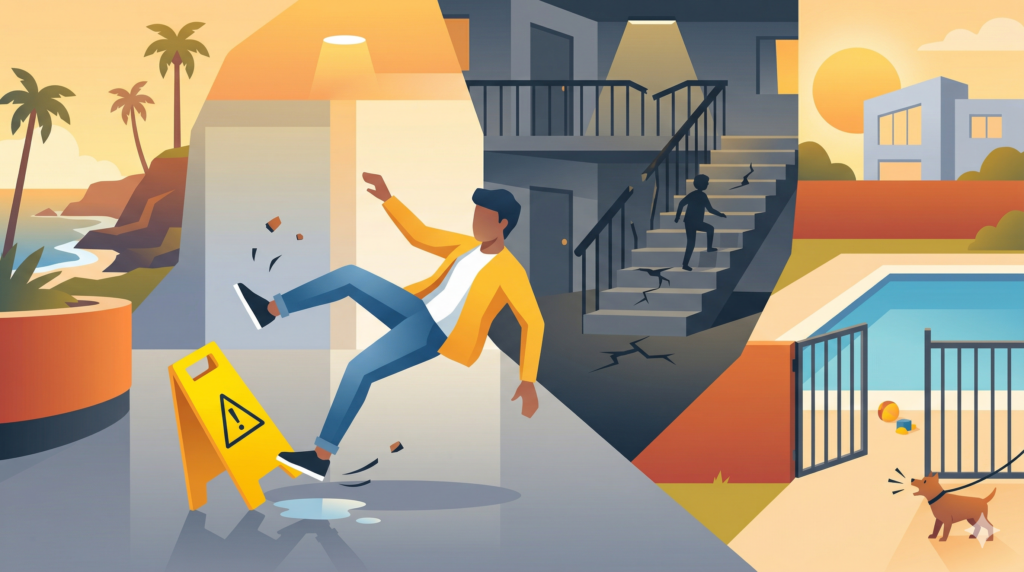
Premises liability covers a wide range of accidents. The cases we see most often across California include:
Knowing where liability stops helps you understand how insurers will attack your claim. Common defenses include:
These defenses are narrower than insurers often suggest. An adjuster who claims the hazard was obvious has not settled the question of liability.
Yes. California follows a pure comparative negligence rule, so partial fault reduces your compensation rather than eliminating it. If a jury values your claim at $100,000 and finds you 20 percent responsible, you recover $80,000.
Expect the property owner’s insurer to push your share of fault as high as possible. They will point to your shoes, your phone, or a warning sign you supposedly ignored. Strong evidence from the scene is how you push back.
You generally have two years from the date of injury to file a lawsuit under California Code of Civil Procedure Section 335.1. If a city, county, or other public entity controls the property, you typically must file a government claim within six months.
Waiting also costs you evidence. Surveillance footage is often erased within days or weeks, and hazards get repaired. The sooner an attorney sends a preservation letter, the more of that proof survives.
The strongest claims are built in the first days after an injury. If you are able, gather or preserve:
Your attorney can then pursue what you cannot get on your own. That includes surveillance footage, maintenance logs, inspection records, and prior complaints about the same hazard.
Property owners and their insurers start building their defense the day you are hurt. We start building your case just as fast. Our team investigates the scene, demands preservation of footage and records, and works with safety experts when the hazard requires it.
You get direct attorney attention from the first call. We handle the insurers, the paperwork, and the deadlines so you can focus on your recovery. If an insurer refuses to pay what your claim is worth, we are prepared to take your case to trial.
Yes, if they can show you were negligent in maintaining the property and that negligence caused their injury. Most homeowners have liability coverage that handles these claims. A tripping injury alone does not prove the owner did anything wrong.
Most homeowners and renters policies include liability coverage for guest injuries, and many add medical payments coverage. Coverage limits and exclusions vary by policy. The injured person's claim is typically made against the owner, with the insurer handling the defense and payment.
Value depends on your medical costs, lost income, long-term effects, and how clearly the owner was at fault. Pain and suffering can make up a significant part of the recovery. Our guide on how much you can get for a slip and fall in California explains the factors that drive value.
No. Our firm handles premises liability cases on a contingency basis. You pay no fees unless we win your case.
If an unsafe property caused your injury, our team will hold the responsible party accountable and fight to recover full compensation. Real people, real results.
Don’t pay any fees unless we win your case.