
Hit by flying debris on a California freeway? Learn which auto insurance covers your damage, when comprehensive vs collision applies, deductibles, and how to file the right claim.

Erick is extremely passionate about issues involving injustices where there is an apparent imbalance of power. Whether the imbalance involves a large corporation or a government entity that denies responsibility and minimizes the harm they have inflicted on his clients, Erick prides himself in helping victims obtain full and complete compensation.
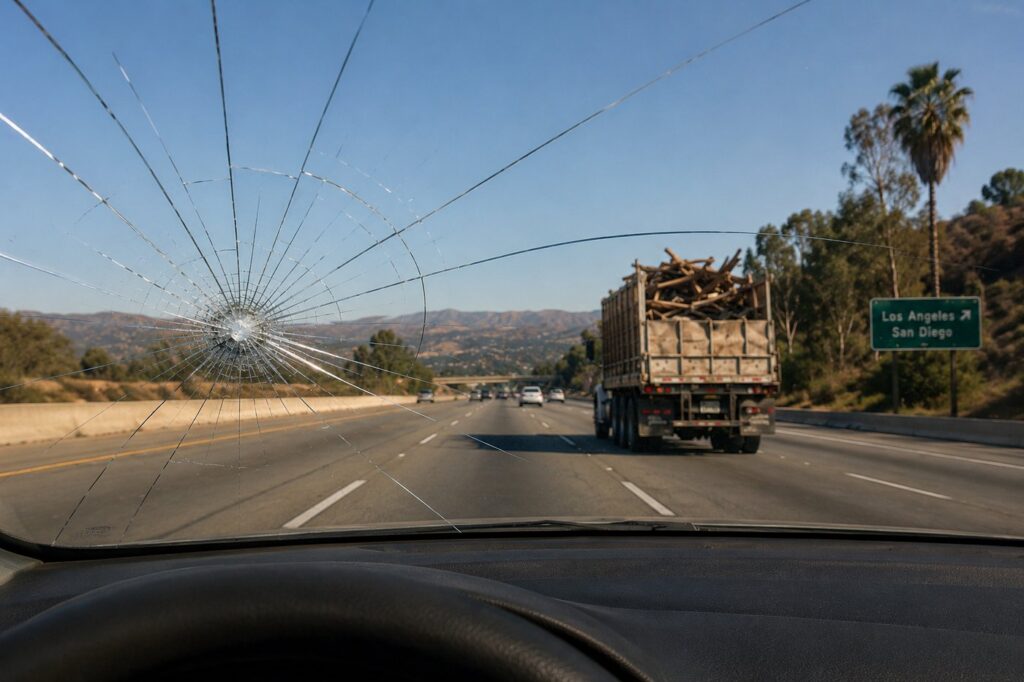
The short answer is yes, in most cases, but which policy pays (yours or the at-fault driver’s) depends entirely on whether the source of the debris can be identified. A rock off the SR-14, a chunk of tire tread on the I-405, cargo that shakes loose on the 710: California drivers file thousands of flying debris claims every year, and choosing the right type of claim can mean the difference between absorbing a $1,000 deductible and recovering full damages from the trucking company that dropped the load. This guide breaks down which coverage applies when, how to file the claim correctly, and when to bring in a California personal injury attorney instead of (or in addition to) your insurer.
Four different types of coverage can apply to flying debris incidents in California. Knowing which one fits your situation is the first decision that affects everything else.
Comprehensive auto insurance, sometimes called “other than collision” or “OTC” coverage, pays for damage to your vehicle from events outside your control: theft, vandalism, weather, animal strikes, fire, falling objects, and flying debris from unknown sources. If a rock hits your windshield on the SR-14, a piece of tire tread strikes your hood on I-405, or debris falls from an unidentified truck on the 710, comprehensive coverage is what pays.
Your insurer covers the repair cost minus your deductible, regardless of fault. Comprehensive is optional in California (unlike liability coverage, which is required at minimum $15,000/$30,000/$5,000 limits), so if you carry only the state minimums, you may have no coverage for unidentified-source debris damage.
Collision coverage applies when your vehicle hits something: another car, a guardrail, a tree, a wall. Flying debris damage is technically the opposite scenario: something hit your stationary or moving car. Most California insurers treat debris claims as comprehensive events, not collision events.
The exception is when you actively swerve to avoid debris and hit something else as a result (a guardrail, another vehicle, a center divider). In that situation, the resulting impact may fall under collision rather than comprehensive. Filing under the wrong type of coverage can trigger denial and slow your claim, so confirming the right category upfront matters.
When you can identify the vehicle that dropped the debris (license plate, USDOT number, company markings), you can file a third-party claim against the driver’s liability insurance instead of (or in addition to) your own comprehensive coverage. The at-fault driver’s policy pays for both property damage and bodily injury, and there’s no deductible on a third-party claim.
Commercial trucks carry much higher policy limits than passenger vehicles, typically $1 million in California, with major freight carriers carrying $5 million or more for hazardous loads. When the source vehicle is commercial, pursuing the third-party claim almost always produces a larger recovery than relying on your own coverage.
Many California drivers don’t realize their Uninsured Motorist coverage may apply when the at-fault driver flees or can’t be identified. UMPD covers property damage from uninsured drivers, and some California policies extend it to hit-and-run scenarios that include cargo-spill incidents where the source truck didn’t stop. The exact terms vary by insurer, so check your policy declarations page before assuming you have no recourse.
Uninsured Motorist Bodily Injury (UMBI) handles the injury side of the same scenarios and is often the only path to recovery when a fleeing commercial truck causes serious injuries.
The payout depends on the type of coverage, the extent of damage, and how aggressively you advocate for full repair value. Here’s what to expect at each step.
Comprehensive deductibles in California typically range from $250 to $1,000, with $500 being the most common. Your insurer pays the repair cost above your deductible. For minor windshield chips or small dents, the repair cost may not exceed the deductible, in which case filing a claim doesn’t make financial sense (and may even raise your premium).
For major damage, the deductible is a one-time cost regardless of total repair value. California offers a notable exception: many comprehensive policies waive the deductible specifically for windshield repairs (chips and small cracks) but not full windshield replacement. Check your policy or call your agent to confirm.
If repair costs exceed approximately 70 to 80 percent of your vehicle’s actual cash value (varies by insurer), the insurance company will declare the vehicle a total loss instead of repairing it. You’ll receive a settlement equal to the actual cash value (ACV) of your vehicle pre-incident, minus your deductible and any salvage value. ACV is determined by comparable sales in your local market, not the Kelley Blue Book retail price.
If you believe the insurer’s ACV is too low, you can dispute it with independent comparable listings and an appraisal. Total loss disputes are one of the most common reasons drivers contact a personal injury attorney after a flying debris claim.
Rental reimbursement is a separate optional coverage that pays for a rental car while your vehicle is being repaired. It’s typically $30 to $50 per day with a 30-day maximum. If you don’t carry rental reimbursement and the at-fault commercial trucker’s insurance is paying the claim, their liability coverage typically includes rental reimbursement as part of the property damage payout. Always ask about rental coverage at the start of any claim.
Most flying debris insurance claims are won or lost in the first 48 hours. Take these steps in order to protect your recovery.
Photograph the debris itself, the damage to your vehicle, the location, the weather, any visible identifiers on the source vehicle (license plate, company name, USDOT number, trailer markings), and any witnesses’ vehicles. Note the exact time, freeway, milepost or exit, and direction of travel. Dashcam footage, if available, is the single most valuable evidence in a debris claim. Save it immediately so it isn’t overwritten by your dashcam’s rolling memory.
For damage over a few hundred dollars or any injuries, file a police report with the California Highway Patrol (for freeway incidents) or local police (for surface streets). A police report creates the official documentation that anchors every subsequent insurance claim. For freeway incidents, dial the CHP non-emergency line if the scene is stable, or 911 if there are injuries or active danger to other drivers.
Open the claim within 24 to 48 hours. Provide the basic facts (date, time, location, what happened, photo documentation) but be careful about recorded statements. Insurance adjusters are trained to ask questions designed to minimize the insurer’s payout.
You’re not required to give a recorded statement at the first call, and you have the right to consult with an attorney before doing so. State the facts, decline to speculate about fault or value, and ask for written confirmation of the coverage being applied.
The insurer will offer to send you to their preferred repair shops, but you’re not required to use them. Get at least one independent estimate from a body shop of your choosing. If the insurer’s offer is below your independent estimate, you can negotiate.
Document everything in writing. If the insurer is offering less than what’s needed to make you whole, that’s a signal to involve a personal injury attorney, especially if injuries are also involved.
These are the most frequent errors we see in California flying debris claims, in rough order of how much they cost claimants:
For minor property-damage-only claims with no injuries, insurance is usually sufficient. But certain situations call for a personal injury attorney rather than (or in addition to) your insurer:
Hitting unidentified debris is typically not treated as an at-fault accident by California insurers because there’s no other driver to assign fault to. Comprehensive claims (which is what most debris incidents become) are categorized as no-fault events, similar to weather damage or theft. This generally means premium increases are smaller, or absent, compared to collision claims where you’re found to be at fault. However, each insurer’s underwriting practices vary, and a pattern of multiple comprehensive claims in a short period can still raise rates.
For a single comprehensive claim with no fault assignment, the impact on premiums is usually modest or zero, particularly with insurers that offer accident forgiveness. Multiple claims within a short window are more likely to trigger rate increases. If the damage is below your deductible, filing a claim doesn’t make sense because you’ll pay out of pocket anyway and your rates may still tick up. For larger claims, the deductible savings far outweigh any potential rate adjustment.
Unknown-source debris incidents are exactly what comprehensive coverage is designed for. File the claim under comprehensive, document the damage and incident details thoroughly, and your insurer will pay repair costs minus your deductible. The lack of an identified source vehicle doesn’t disqualify the claim, it just channels it through first-party coverage rather than third-party.
Yes, in most cases. Tire damage from road debris (nails, screws, tire tread fragments from prior blowouts, sharp metal pieces) is generally covered under comprehensive in California. The catch is that minor punctures often cost less than the deductible, making out-of-pocket repair cheaper than filing a claim.
For multi-tire damage scenarios (common when nails or screws spill from a construction or trucking vehicle), the combined repair cost often exceeds the deductible and the claim is worth filing. If the source vehicle can be identified, a third-party liability claim is almost always the better path.
You may be able to. If you got the license plate, USDOT number, or company markings before the truck left the scene, your attorney can pursue a third-party claim against the trucking company’s insurance even if the driver fled. California’s hit-and-run laws also create criminal liability for commercial drivers who flee debris incidents that cause injury.
If no identifying information was recoverable, your Uninsured Motorist Property Damage (UMPD) coverage may apply to hit-and-run scenarios. Our California truck collision attorneys handle these investigations regularly.
If flying debris damaged your car or caused injuries on a California highway, and your insurer is offering less than your damages are worth (or denying the claim entirely), we can help. Novik Law Group has spent over 12 years handling California flying debris cases, from windshield-only property damage claims to catastrophic injury and wrongful death litigation.
For the full legal picture beyond insurance, read our companion guide: Flying Debris Hit My Car: Your Legal Options in California. Attorney Erick Novik personally handles serious debris-related injury cases statewide. Call us today for a free, no-obligation case evaluation. We don’t charge any fees unless we win your case.
If flying debris damaged your vehicle or caused an injury on a California freeway, and your insurer isn’t offering what your claim is worth, our team of experienced California truck accident attorneys will fight to recover full compensation.
No cost consultation.
Please call us today and let us help you.