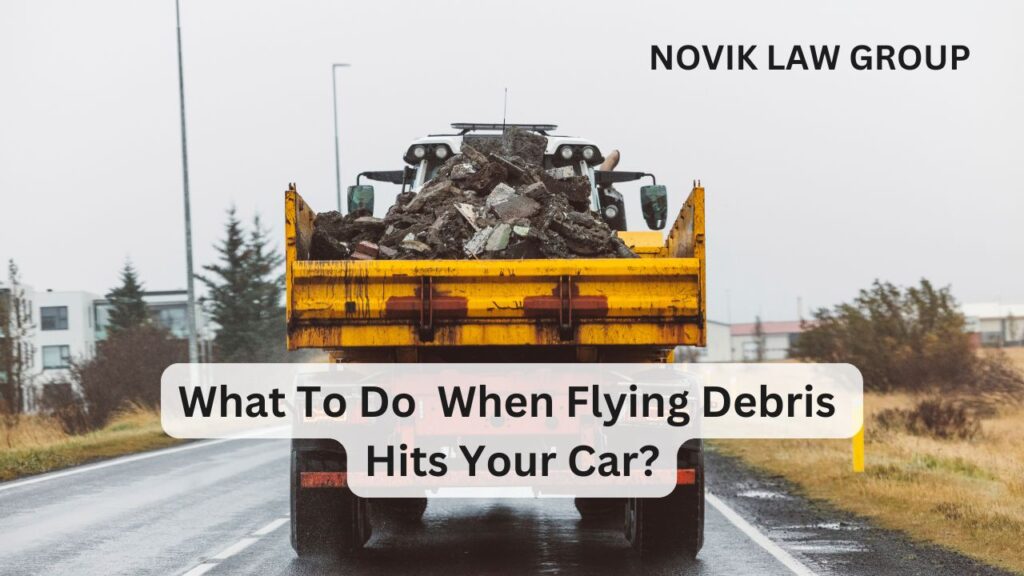
If flying debris hit your car on a California freeway or highway, your legal options depend entirely on the source of the debris. When debris came from another vehicle’s improperly secured load, you can pursue a liability claim against the driver and — for commercial vehicles — the trucking company, under California Vehicle Code §23114. When debris resulted from poor maintenance or unaddressed hazards on a state highway, you may have a
Caltrans negligence claim under California Government Code §835. And when the source can’t be identified, your own comprehensive auto insurance typically covers the damage. An experienced California car accident lawyer can identify every potentially responsible party, navigate the complex insurance issues, and pursue the full compensation you’re owed — including medical bills, lost income, vehicle repair costs, and pain and suffering damages. Novik Law Group handles flying debris cases on contingency. We don’t charge any fees until we win your case.
What Is Flying Debris on California Highways?
Flying debris is any airborne object or material on or above a roadway — and on California’s freeways, it’s responsible for thousands of vehicle collisions and injuries every year. Common examples include trash, tools, tire treads and blowout fragments, construction materials, gravel and rocks, tree branches, fallen cargo from improperly secured truck loads, and even traffic signs or light poles dislodged in storms. The California Highway Patrol regularly fields reports about debris hazards on I-5, US-101, I-405, I-10, and the SR-14 — corridors where high traffic volumes and dense commercial freight concentrate the risk.
Whether you slam into debris, swerve violently to avoid it, or get struck by an airborne object thrown from a vehicle ahead, the consequences range from minor windshield chips to catastrophic injuries. Common injuries include whiplash from sudden braking, head trauma from windshield impacts, lacerations and burns, back and neck injuries, and serious emotional trauma. When commercial truck cargo causes the crash, injuries can be fatal, and surviving family members may have
wrongful death claims alongside the property damage recovery.
California Road Debris Laws and Cargo Securement Rules
California enforces strict laws holding drivers, businesses, and government agencies responsible for keeping roadways clear of debris and dangerous conditions. Three legal authorities matter most in flying debris cases:
California Vehicle Code §23112 Dumping on Highways
CVC §23112 prohibits anyone from depositing or causing to be deposited any glass, nails, tacks, wire, cans, or substance likely to injure people or damage vehicles onto any California highway. Violators face fines and civil liability for accidents their conduct causes.
California Vehicle Code §23114 Vehicle Loads
CVC §23114 requires every vehicle on a California highway to be constructed, covered, and loaded so that nothing — cargo, equipment, or contents — can blow, drop, sift, leak, or escape onto the roadway. This statute applies to passenger vehicles and commercial trucks alike. Violations of CVC §23114 create a presumption of negligence in civil personal injury cases, which significantly strengthens any claim against the driver or owner of the vehicle that dropped the debris.
California Government Code §835 Dangerous Condition of Public Property
Gov Code §835 governs claims against Caltrans, counties, and cities for accidents caused by dangerous roadway conditions — including debris hazards that the public entity knew about (or should have known about) and failed to remove within a reasonable time. Government claims have a strict six-month filing deadline under the California Government Claims Act, which is far shorter than the standard two-year personal injury statute. Missing this deadline can permanently bar your right to recovery against the state.
Who Is Financially Responsible When Flying Debris Hits Your Car?
California law assigns liability based on where the debris originated and who had a duty to prevent it. The same accident can implicate multiple defendants, and identifying every responsible party is critical to maximizing your recovery:
Drivers and Owners of Vehicles With Unsecured Loads
Under California Vehicle Code §23114, the driver and owner of any vehicle that drops debris onto the roadway can be held liable for resulting injuries and damage. To pursue this claim, the source vehicle must be identified — license plate, company name, or other identifying information. Civil liability covers vehicle repair costs, medical expenses, lost wages, and pain and suffering. For commercial vehicles, the trucking company shares liability with the driver under California’s “respondeat superior” doctrine, often substantially increasing the available recovery.
Trucking Companies, Freight Brokers, and Cargo Loaders
Commercial truck cargo cases get complicated quickly. The trucking company is typically liable for the driver’s actions, but the cargo loader (who may be a third-party at the shipping facility) and the freight broker (who arranged the shipment) can share liability when securement was their responsibility. Federal Motor Carrier Safety Administration rules govern how cargo must be tied down on commercial vehicles, and violations of those rules — captured in pre-trip inspection records, driver logs, and maintenance histories — become central evidence in California
truck collision claims.
Caltrans and Other Public Entities
When debris is on the roadway because of poor maintenance or government negligence — fallen tree branches not removed, defective guardrails, accumulated construction debris, sinkholes, missing or non-working signage — Caltrans or the responsible city or county can be held liable under California Government Code §835. These cases require proving the government had notice of the hazard and failed to fix it within a reasonable time. Maintenance records, prior accident reports at the same location, and CHP hazard reports become the evidence backbone.
When the Source Can’t Be Identified
If the debris source vehicle flees or can’t be identified — a frequent scenario on busy California freeways — your own comprehensive auto insurance typically covers the property damage. For bodily injury, your Uninsured Motorist (UM) coverage may apply depending on policy specifics. Many California drivers don’t realize their UM coverage extends to unidentified-driver scenarios, which is exactly when it’s most needed.
When Flying Debris Comes From a Truck: California Cargo Spill Liability
Commercial truck cargo causes some of the most severe flying debris accidents on California highways. Tractor-trailers can carry tens of thousands of pounds of cargo, and a load that breaks free at freeway speed becomes a deadly projectile. The legal picture in these cases is also more complex — multiple parties typically share liability, and the available insurance coverage is substantially higher than in passenger-vehicle cases.
Who Can Be Held Liable in a Truck Cargo Spill Case
The driver is the most obvious defendant, but rarely the only one. The trucking company employing the driver carries the largest insurance policy and is responsible for hiring decisions, training, equipment maintenance, and schedule pressure. The cargo loader — often a third-party warehouse or shipping facility — may be liable when securement was their responsibility under federal cargo securement rules (49 CFR Part 393). The freight broker who arranged the shipment can share liability if they failed to verify the carrier’s qualifications. The truck or trailer manufacturer can be liable if defective tie-downs, latches, or trailer doors contributed to the cargo escape. And the cargo owner (the company shipping the goods) may share liability for inadequate packaging.
Evidence That Makes or Breaks a Truck Cargo Case
Federal Motor Carrier Safety Administration rules require commercial trucks to maintain extensive records — electronic logging device (ELD) data, pre-trip inspection logs, bills of lading, securement inspection records, driver qualification files, and post-trip inspection notes. We subpoena all of these to establish whether cargo securement was inspected before the run, whether the driver had been pressured to skip rest breaks, and whether the loading facility followed federal securement standards. These records are also subject to retention rules, but trucking companies sometimes “lose” them — which itself becomes evidence of spoliation.
Common Truck Cargo Scenarios in California
The I-5 corridor between Mexico and Oregon, the I-10 between Los Angeles and the Inland Empire, and the I-710 serving the Port of Long Beach see disproportionate truck cargo incidents because of freight volume. Common spill scenarios include unsecured construction materials, lumber and steel falling off flatbeds, gravel and aggregate from dump trucks, mattresses and furniture from rental trucks, and produce or palletized goods from refrigerated trailers. When fatigue contributes — and it often does — we add
drowsy driving claims alongside the cargo securement claim. Catastrophic outcomes can support
jackknife or
underride claims when the trailer itself becomes a hazard.
When Caltrans Is Responsible for Flying Debris and Road Hazards
The California Department of Transportation (Caltrans) is responsible for keeping state highways clear of debris and free from dangerous conditions. When Caltrans fails — when fallen tree branches stay on the roadway for days, when construction debris isn’t cleared after a project, when sinkholes or defective guardrails go unrepaired — the state can be held liable for resulting accidents under California Government Code §835. But these cases require specific evidence and follow a procedure that’s fundamentally different from suing a private party.
Proving Caltrans Had Notice of the Hazard
Government Code §835 requires proof that Caltrans had actual or constructive notice of the dangerous condition before your crash. Actual notice means someone reported it directly. Constructive notice means the condition existed long enough that Caltrans should have discovered it through reasonable maintenance inspections. We pull Caltrans maintenance logs, prior CHP hazard reports for the same location, prior accident reports, and inspection schedules to establish the timeline. The California Highway Patrol typically reports road hazards to Caltrans, which creates a written paper trail of notice that’s central to any subsequent claim.
The Six-Month Government Claim Deadline
Unlike standard personal injury cases — where you have two years to file a lawsuit — claims against Caltrans must be filed in writing within six months of the date of injury under the California Government Claims Act. The written claim must include specific information about the incident, injuries, and damages requested. Procedural mistakes can result in permanent dismissal. After Caltrans rejects the claim (or fails to respond within 45 days), you have six additional months to file a lawsuit in civil court. The total clock is short, and identifying Caltrans as a defendant early matters. Our
California Caltrans negligence attorneys handle these cases statewide.
Common Caltrans Debris Scenarios
Tree branches falling from non-maintained right-of-way trees. Construction debris left behind after Caltrans-managed projects. Defective signage that falls onto the roadway. Guardrail components dislodged after prior accidents and not replaced. Sinkholes and pavement failures. Rocks and gravel from unstable hillsides during California’s wildfire-driven debris flow season. Each scenario implicates different Caltrans duties — design, inspection, maintenance, or post-incident remediation.
Dangerous roadway claims often run parallel to Caltrans negligence claims, particularly when defective design contributed to the hazard.
Does Insurance Cover Flying Debris Damage in California?
Insurance coverage for flying debris damage in California depends entirely on which coverage you carry and where the debris came from. Understanding which policy applies — yours or the at-fault driver’s — can make the difference between full recovery and paying out of pocket.
Insurance coverage decisions can shape your entire recovery from a flying debris incident, and the rules are more nuanced than a single section can cover. For the full breakdown of comprehensive vs collision coverage, deductible strategies, when to file a third-party claim against the at-fault driver, how Uninsured Motorist Property Damage (UMPD) works in California, and the five most common insurance claim mistakes that reduce payouts, read our dedicated companion guide:
Does Insurance Cover Flying Debris Damage in California?
That guide walks through the exact step-by-step process for filing a flying debris claim with your insurer, when to escalate from insurance to legal action, and answers to the most common insurance questions California drivers ask after a debris strike on the freeway.
Comprehensive Coverage: When Your Own Policy Pays
Comprehensive auto insurance — sometimes called “other than collision” or “OTC” coverage — generally covers damage from flying debris when the source can’t be identified. This includes scenarios like a rock striking your windshield from no obvious source, debris falling from an unknown vehicle that flees, or natural debris like falling tree branches. Your comprehensive coverage pays for repairs minus your deductible. If you don’t carry comprehensive (it’s optional in California, unlike collision and liability minimums), you’ll have no coverage for unidentified-source debris damage.
Collision Coverage: Why It Usually Doesn’t Apply
Collision coverage applies when your vehicle hits something — another car, a guardrail, a wall. It generally does NOT cover situations where flying debris hits your stationary or moving car. The legal distinction matters: collision means you struck something; debris damage is the opposite. Filing under the wrong coverage type can result in claim denial.
Third-Party Claims: When the Other Driver’s Insurance Pays
When you can identify the at-fault vehicle — the truck that dropped the load, the pickup with the unsecured tools — you can file a third-party claim against their insurance. The at-fault driver’s liability coverage pays for both property damage and bodily injury. Commercial trucks carry significantly higher policy limits than passenger vehicles (typically $1 million in California, with major freight carriers carrying $5 million or more for hazardous loads). When the source vehicle is commercial, pursuing the third-party claim usually produces much larger recoveries than relying on your own coverage.
Uninsured Motorist Property Damage (UMPD) Coverage
Many California drivers don’t realize their Uninsured Motorist coverage may apply when the at-fault driver flees or can’t be identified. UMPD covers property damage from uninsured drivers, and some California policies extend it to unidentified-driver hit-and-run scenarios that include cargo-spill incidents. The exact terms vary by insurer, but it’s worth checking your policy before assuming you have no recourse. Uninsured Motorist Bodily Injury (UMBI) coverage handles the injury side of the same scenarios.
What Adjusters Won’t Tell You
Insurance adjusters often steer you toward filing under your own comprehensive coverage even when a third-party claim against the at-fault driver would produce a better outcome. This benefits the insurer (they pay subrogation later from the at-fault carrier) but can disadvantage you (your deductible applies, your premiums may rise, and the at-fault party isn’t directly held accountable). A California personal injury attorney can identify which claim path makes the most sense for your specific situation — and ensure all coverage layers are pursued.
Specific Damage Types from Flying Debris: Windshields, Tires, and Body Damage
Different types of damage from flying debris involve different claim strategies and different repair pathways. Understanding which type you’re dealing with helps you make smarter decisions about repair, claims, and legal action.
Windshield Damage: Chips, Cracks, and Shattered Glass
Windshield damage is the single most common consequence of flying debris on California highways. Small rock strikes typically produce chips and star cracks; larger debris can shatter the windshield entirely. California law actually treats windshield repairs favorably — many comprehensive policies waive the deductible for windshield repairs (though not full replacement), and California’s “no glass deductible” policies are common for in-state drivers. Get repairs done immediately because chips can spread into full cracks within days, particularly with temperature changes. For shattered windshields, document everything before repair — your photos are evidence if any injury claim arises later.
Tire Damage from Nails, Screws, and Tire Debris
Nails and screws spilled from trucks or construction zones can puncture tires almost immediately. Tire tread debris from earlier blowouts can cause secondary blowouts when struck at speed. Comprehensive coverage typically covers tire damage from road debris, though deductibles may exceed the cost of repair for minor punctures. For multi-tire damage scenarios — common in nail or screw spill incidents — third-party claims against the source vehicle become significantly more valuable than first-party comprehensive claims. Document the tire debris itself at the scene; it’s evidence of the cargo securement failure.
Body Damage, Paint, and Dents
Body damage from flying debris ranges from minor paint chips and dents to major structural damage from larger cargo. Comprehensive coverage applies the same as for windshields, but the deductible matters more here — the typical $500-$1,000 deductible can exceed the cost of minor cosmetic repairs, making out-of-pocket payment the cheaper option for small damage. For larger damage with clear at-fault sources, third-party claims through the source vehicle’s insurance carrier almost always produce better outcomes than first-party coverage.
Injury Damage: When Property Damage Becomes a Personal Injury Case
Property damage alone is usually an insurance matter, not a litigation matter. But when injuries result — whiplash from sudden braking, head trauma from windshield impacts, lacerations from shattered glass, back injuries from violent evasive maneuvers — the case becomes a personal injury claim with damages well beyond vehicle repair. California allows recovery for medical bills, lost wages, future medical care, and pain and suffering.
Our California auto accident attorneys handle the full spectrum of flying debris cases, from windshield-only property damage claims through catastrophic injury and wrongful death litigation.
What to Do If Flying Debris Hits Your Car on a California Freeway
The minutes immediately after a flying debris incident determine how strong your legal case will be. Take these steps in order:
- Pull over safely. Get to a shoulder or off-ramp before doing anything else. Don’t stop in a travel lane — secondary crashes from rear-end impacts are a major risk after debris incidents.
- Call 911 or CHP if there are injuries or significant damage. Even when injuries seem minor, a police report creates the official record that anchors any future claim. For California freeways, dial the CHP non-emergency line if the scene is stable but a report is still needed.
- Photograph everything before anything moves. Capture the debris itself, the damage to your vehicle, the road conditions, lane markings, weather, and any visible identifiers on the source vehicle (license plate, company logos, trailer numbers, USDOT numbers on commercial trucks).
- Get witness contact information. Other drivers may have dashcam footage or may have seen the cargo fall. Their contact details should be documented at the scene before they leave.
- Identify the source vehicle if possible. Note the license plate, vehicle description, company name, and direction of travel. For commercial trucks, the USDOT number and company name on the door are critical — these identify the carrier even if the driver flees.
- Report the road hazard. Call Caltrans Maintenance at 1-800-TELL-CHP (1-800-835-5247) to report ongoing debris that could harm other drivers. This report creates a paper trail useful in establishing notice for government liability claims.
- Seek medical care promptly. Even seemingly minor injuries can mask serious conditions like whiplash or concussion. Documented medical care immediately after the incident is essential evidence.
- Contact your insurance company within 24-48 hours. Open the claim quickly but be careful what you say — adjusters are trained to minimize payouts.
- Talk to a California personal injury attorney before signing anything. If injuries are involved or damages are significant, get legal advice before accepting any settlement or providing recorded statements to insurance companies.
How to Report Flying Debris and Road Hazards on California Highways
Reporting road debris isn’t just a public-safety obligation — it can also strengthen your legal case if Caltrans is later sued for failing to address the hazard. Reports create a documented timeline of notice that becomes critical evidence under California Government Code §835.
How to Report Active Road Hazards
For debris that’s currently on the roadway and creating a danger to other drivers, call the California Highway Patrol non-emergency line at 1-800-TELL-CHP (1-800-835-5247). CHP dispatchers will either send a unit to clear the debris or relay the report to Caltrans Maintenance for clearance. For emergencies — debris causing active crashes or imminent danger — dial 911 directly.
How to Report Damaged Caltrans Infrastructure
For damaged guardrails, missing signs, potholes, downed power lines, broken pavement, or other infrastructure issues, contact Caltrans directly at 1-800-COMMUTE (1-800-266-6883) or through the Caltrans website. Reports about state highways go through Caltrans; reports about city or county roads go to the local public works department. Identifying the correct entity matters because each maintains separate records and follows different response timelines.
Why Reporting Matters for Legal Claims
When Caltrans (or another public entity) is later sued under California Government Code §835 for failing to address a hazard, the key issue is whether the agency had notice. Documented reports — phone calls, written complaints, CHP hazard logs — create the paper trail that establishes notice. If you were hit by debris that another driver had already reported hours or days earlier, that prior report can be the difference between winning and losing a Caltrans negligence claim. Always document your own report: note the time, the dispatcher’s name or report number, and the description you gave.
Reporting Doesn’t Replace Filing a Government Claim
Reporting a hazard to CHP or Caltrans is not the same as filing a government claim under the California Government Claims Act. If you’ve been injured by debris and intend to sue a public entity, you must still file a formal written claim within six months. The hazard report supports the eventual claim — it doesn’t substitute for the legal filing.
How to Prevent Flying Debris Injuries on California Highways
Defensive driving on California’s debris-heavy corridors significantly reduces your risk:
- Maintain extra following distance behind commercial trucks, pickup trucks with open beds, and any vehicle with visible cargo or equipment.
- Watch for tire-tread debris on freeways — blowout fragments are a major hazard, particularly on hot California afternoons when tire failures spike.
- Adjust your lane position to avoid running directly behind unsecured cargo.
- Reduce speed during high winds, storms, and after wildfires — burned vegetation and post-storm debris hazards remain on California roads for days.
- Keep windshield wipers and windshield in good condition. A damaged windshield can shatter inward on impact with even small debris.
- If you see debris on the freeway, do not swerve violently — control the vehicle, brake smoothly, and choose your impact rather than losing control trying to avoid it. Most catastrophic debris crashes happen during evasive maneuvers, not during the debris strike itself.
- Report all debris you spot on California highways by calling 1-800-TELL-CHP. Caltrans crews dispatched on your report can prevent the next driver from being hit.
If flying debris damaged your car or caused injuries on a California highway, the law firm you choose matters. Identifying every liable party, gathering the right evidence quickly, and navigating the California Government Claims Act when Caltrans is involved all require experience most general-practice firms don’t have. Novik Law Group has spent over 12 years handling flying debris and roadway hazard cases throughout California. We coordinate directly with the California Highway Patrol, Caltrans Maintenance, trucking companies, and insurance carriers, and we never take a fee unless we recover compensation for you.
Attorney Erick Novik personally handles serious debris-related injury cases statewide. Call us today for a free, no-obligation case evaluation.
Frequently asked questions about flying debris accidents in California
These answers cover the most common questions after a debris strike on a California road. For broader questions about car accident claims and the injury-claim process, visit our homepage.
What should I do if flying debris hit my car on a California freeway?
Pull over somewhere safe, call 911 or the CHP if there are injuries or significant damage, and photograph the debris, your vehicle, and any identifying information on the source vehicle before anything moves. Get witness contact information, report the hazard to the CHP, seek medical care promptly, and speak with an attorney before giving a recorded statement to any insurer.
Who is responsible when something falls off a truck and hits my car?
Under California Vehicle Code 23114, the driver and owner of a vehicle that drops debris can be liable for the resulting damage and injuries. When the vehicle is a commercial truck, the trucking company usually shares liability, which is why identifying the carrier through the USDOT number and company name matters. These claims often overlap with truck and big rig collision cases.
Something hit my car on the freeway but I could not identify the source. What now?
When the source vehicle flees or cannot be identified, your own comprehensive coverage typically pays for the property damage, and your uninsured motorist coverage may apply to injuries. Which path produces the best outcome depends on your policy, which we break down in our guide to whether insurance covers flying debris damage in California.
Is hitting road debris covered under comprehensive insurance?
Usually yes. Damage from road debris when the source cannot be identified generally falls under comprehensive coverage, not collision, minus your deductible. Filing under the wrong coverage type is a common reason claims get denied.
Is hitting road debris an at-fault accident?
Striking unavoidable debris is generally not treated as an at-fault collision, and a comprehensive claim does not assign fault to you the way a collision claim can. If another driver’s unsecured load caused the debris, the fault rests with that driver, not you.
Who is responsible for road debris damage in California?
It depends on where the debris came from. A driver or trucking company with an unsecured load can be liable under Vehicle Code 23114, a public agency like Caltrans can be liable under Government Code 835 for a hazard it failed to clear, and when no source can be found, your own coverage applies.
How long do I have to file a claim after a debris accident?
The general deadline for a personal injury claim in California is two years. If a government entity like Caltrans is responsible, you must file a written government claim within six months, so it is important to identify the responsible party early.